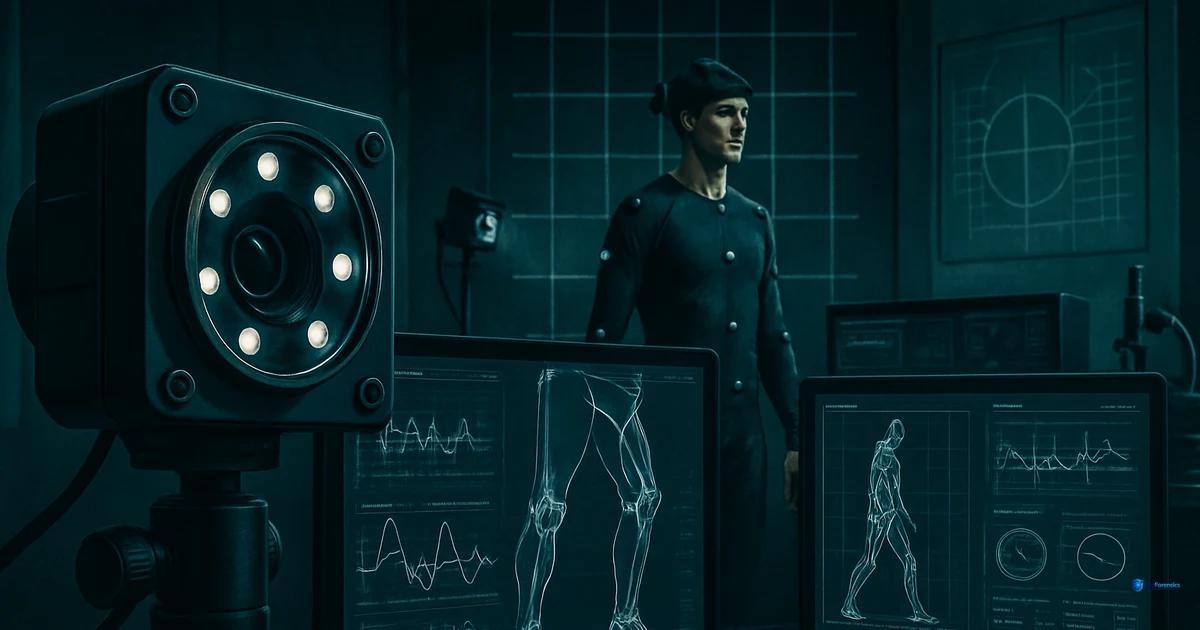
How Motion Analysis Detects AI Generated Humans
Real humans move with biomechanical constraints that AI generators have not fully learned. Motion analysis reveals these gaps.
How Motion Analysis Detects AI Generated Humans
The human body moves within a tightly constrained biomechanical envelope. Joints have limited ranges of motion, muscles fire in coordinated patterns, and years of neuromuscular development produce gait signatures that are remarkably consistent for each individual. When an AI generates a synthetic human in video, it must reproduce all of these constraints simultaneously — and even subtle violations can serve as forensic signals.
Human Motion Constraints
Real human movement is governed by a hierarchy of physical and biological constraints:
- Joint limits: Every joint in the human skeleton has a defined range of motion. The elbow, for instance, can flex to roughly 145° and extend to about 0° — it cannot hyperextend significantly without injury.
- Musculoskeletal physics: Movement is produced by muscles pulling on bones across joints. This means motion at one joint propagates through the kinematic chain — shoulder movement affects the elbow, which affects the wrist.
- Gait patterns: Human walking and running follow highly stereotyped patterns involving coordinated hip, knee, and ankle flexion, reciprocal arm swing, and centre-of-mass management that are difficult to replicate without physics simulation.
- Involuntary motion: Real humans exhibit constant micro-movements — postural sway, breathing-induced torso motion, and eye saccades — that are statistically complex and temporally structured.
Why AI Generators Struggle with Human Motion
Most video generation models learn motion from 2D training data without an explicit physics simulation layer. This leads to several characteristic shortcomings:
- The model may generate plausible poses frame-by-frame but fail to ensure smooth, physically valid transitions between them.
- Without a skeletal model, the generator has no built-in knowledge of joint limits, so limbs may occasionally bend beyond anatomical constraints.
- Training data often under-represents edge-case motions (stumbling, catching a thrown object, dynamic balance recovery), causing the model to hallucinate implausible movement in these scenarios.
- Fine-grained coordinated motion — such as the reciprocal arm-leg swing of walking — may lose synchronisation over longer clips, producing a subtle but measurable phase drift.
Gait Analysis as a Forensic Signal
Human gait is one of the most studied biomechanical patterns. A normal walking cycle involves a precise sequence of heel strike, midstance, toe-off, and swing phase, with characteristic timing ratios that vary modestly between individuals but fall within a well-documented range. Forensic gait analysis examines:
- Stride length and cadence: AI-generated walkers may exhibit stride lengths or step frequencies that fall outside the normal human range for the apparent walking speed.
- Double-support timing: The fraction of the gait cycle where both feet are on the ground is tightly constrained by physics. Deviations can suggest the motion was not derived from real biomechanics.
- Arm swing coordination: In authentic walking, arm swing is contralateral (opposite arm and leg move forward together) and proportional to stride length. Loss of this coordination is a potential indicator of synthetic motion.
Micro-Movements and Involuntary Motion
Even when standing still, a real human is never truly motionless. The body exhibits continuous micro-movements driven by:
- Breathing: Rhythmic expansion and contraction of the thorax, typically at 12–20 cycles per minute, producing subtle vertical and lateral torso displacement.
- Postural sway: The body's centre of mass oscillates within the base of support at roughly 0.5–2 Hz. This sway has characteristic spectral properties that differ from random noise.
- Eye saccades: Rapid, ballistic eye movements occur 3–4 times per second. In high-resolution video, the temporal pattern of saccades and fixations can be analysed for plausibility.
- Facial micro-expressions: Brief involuntary facial movements (lasting 40–200 ms) occur in response to emotional stimuli and follow well-documented temporal profiles.
AI-generated humans often exhibit either too little involuntary motion (an unnervingly still torso) or poorly structured micro-movements that lack the spectral characteristics of real biological oscillation.
Joint Articulation Analysis
By fitting a pose-estimation model to each frame and extracting joint angles over time, forensic systems can check whether the observed motion respects anatomical constraints:
- Elbow: Should not exceed approximately 145° of flexion or hyperextend beyond 0–10° in normal motion.
- Knee: Full extension is near 0°; flexion in normal walking rarely exceeds 60° during swing phase.
- Ankle: Dorsiflexion is typically limited to 15–20°; plantarflexion to about 50°.
- Wrist: Extension and flexion are each limited to roughly 70–80°.
A single frame with a joint angle outside the anatomical range is not conclusive — pose-estimation noise and unusual but valid poses (yoga, dance) can produce outliers. However, systematic violations across multiple frames or multiple joints are a stronger signal.
How Forensic Platforms Use Motion Analysis
The ClipForensics forensic modules include a biomechanical analysis component that extracts 2D pose sequences from video and evaluates them against anatomical and kinematic reference models. The module computes per-frame joint-angle compliance scores, gait-cycle regularity metrics, and micro-movement spectral features, then feeds these into the multi-signal scoring pipeline.
Motion analysis is most effective for clips that contain significant human movement — walking, gesturing, turning. Static portraits with minimal body motion provide fewer biomechanical data points. Similarly, very low-resolution footage may not support reliable pose estimation. For a candid overview of what these tools can and cannot do, see our detection limitations page.
Biomechanical Signals and Detection Reliability
| Signal | What It Measures | Detection Reliability | Caveats |
|---|---|---|---|
| Joint angle exceedance | Frames where joint angles exceed anatomical limits | Moderate–High | Pose-estimation errors and hypermobility can cause false positives |
| Gait cycle irregularity | Deviations from expected stride timing and coordination | Moderate | Injuries, footwear, and terrain can legitimately alter gait |
| Arm-leg phase drift | Loss of contralateral coordination during locomotion | Moderate–High | Carrying objects or asymmetric loads can alter arm swing |
| Breathing rhythm absence | Missing or irregular torso displacement at breathing frequency | Moderate | Low resolution or heavy clothing may obscure breathing signal |
| Postural sway spectrum | Spectral characteristics of centre-of-mass oscillation | Moderate | Requires relatively high spatial resolution and stable framing |
| Kinematic chain violation | Child joints moving independently of parent joints | High | Strong signal when present; rarely seen in authentic video |
Frequently Asked Questions
Can motion analysis detect all types of AI-generated humans?
Not all. Motion analysis is most effective when the generated human is performing visible, extended movement such as walking or gesturing. Static or near-static generated portraits — where the subject barely moves — provide far fewer biomechanical data points and may not trigger motion-based anomaly detectors. For such cases, other modules like lighting physics analysis may be more informative.
Does motion analysis work on face-swap deepfakes?
It can, but its utility depends on the type of swap. If only the face texture is replaced while the original body motion is preserved, the biomechanics of the body will be authentic and motion analysis may not flag the manipulation. If the deepfake involves generating or re-animating the full body, motion analysis becomes significantly more relevant.
How accurate is pose estimation on low-resolution video?
Pose estimation accuracy degrades as resolution decreases. Below roughly 256 pixels of subject height, joint localisation errors increase substantially, which can produce false positives in joint-angle analysis. ClipForensics accounts for estimated pose confidence when weighting biomechanical signals in the overall score.
Could an AI generator learn to produce perfectly realistic human motion?
In principle, yes — particularly if future models incorporate explicit physics simulation or train on motion-capture data with biomechanical annotations. As generators improve, forensic tools will need to analyse increasingly subtle motion features. This is an active area of research, and no detection method should be assumed to remain effective indefinitely.
Can I upload a video to test motion analysis?
Yes. Submit your video through the ClipForensics upload tool and the scan report will include biomechanical analysis results alongside all other forensic modules. For related reading, see our articles on optical flow detection and compression artifact analysis.