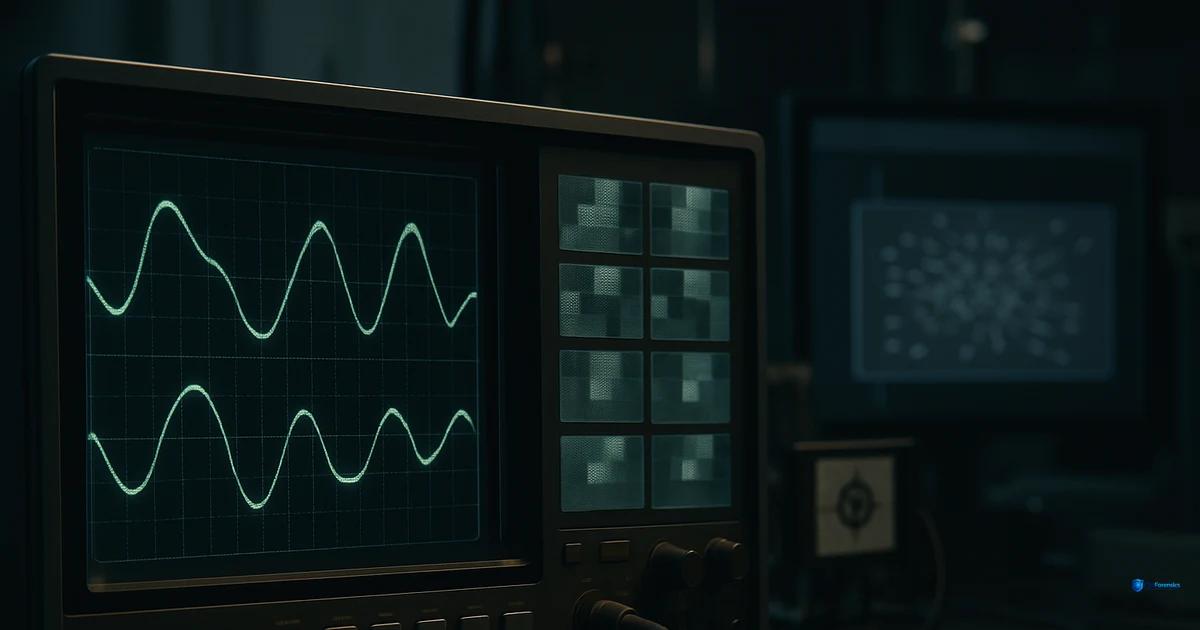
How Optical Flow Reveals AI Generated Video
Optical flow measures how pixels move between video frames. AI generators struggle with motion physics — and that struggle leaves detectable traces.

How Optical Flow Reveals AI Generated Video
Optical flow is the mathematical measurement of apparent pixel motion between consecutive video frames. By tracking how brightness patterns shift from one frame to the next, forensic analysts can build a detailed picture of motion within a scene — and that picture often exposes synthetic video that would otherwise pass casual inspection.
What Is Optical Flow?
At its core, optical flow estimates a velocity vector for every pixel (or region) in a frame, describing where that pixel "moved" in the subsequent frame. Dense optical flow algorithms such as Farnebäck or RAFT produce a full-resolution flow field, while sparse methods like Lucas-Kanade track selected feature points. The resulting flow field can be visualised as a colour-coded map where hue represents direction and saturation represents speed.
In authentic footage, optical flow fields obey the physics of the real world: objects decelerate before changing direction, rigid bodies move as a unit, and camera motion produces globally coherent parallax. When a generative model fabricates motion, these constraints are frequently violated in subtle but measurable ways.
Why Generative Models Struggle with Motion Physics
Current video-generation architectures — including diffusion-based and autoregressive models — learn motion distributions from training data rather than simulating physics. This means the generated motion maylook plausible at a glance but can fail to respect:
- Object permanence: Items may appear, disappear, or morph between frames without physical cause.
- Inertia and momentum: Objects may change velocity instantaneously, ignoring mass and friction.
- Gravity: Falling or thrown objects may follow trajectories that contradict gravitational acceleration.
- Biological constraints: Limbs may bend beyond anatomical joint limits or move without the coordinated muscle activations seen in real human motion.
These failures are often invisible to the naked eye in a single frame, but they produce distinctive signatures in the optical flow field that forensic tools can flag.
How Investigators Use Motion Analysis
Forensic examiners typically employ three complementary approaches when analysing optical flow for signs of manipulation:
- Flow field visualisation: Rendering the flow as a colour map allows analysts to spot spatial discontinuities — abrupt boundaries where motion direction or magnitude changes in a way that is physically implausible.
- Motion magnitude histograms: By plotting the distribution of flow magnitudes across a clip, analysts can detect anomalous peaks or gaps. Authentic video tends to produce smooth, unimodal or bimodal distributions, while synthetic video may show unusual clustering.
- Temporal coherence scoring: Measuring how smoothly the flow field evolves over time reveals "jitter" or sudden transitions that suggest frame-level generation rather than continuous capture.
Common Motion Artifacts in AI-Generated Video
While no single artifact can prove a video is synthetic, certain motion patterns are observed more frequently in generated content:
- Objects changing direction without any visible deceleration phase, suggesting the model sampled a new trajectory rather than simulating momentum.
- Limbs translating through space without respecting joint-chain kinematics — for instance, a forearm rotating independently of the upper arm.
- Camera motion that violates physical inertia, such as an abrupt pan reversal with zero settling time, which would be impossible with any real camera rig or handheld setup.
- Background elements drifting at rates inconsistent with the parallax implied by foreground motion, indicating the model generated foreground and background layers semi-independently.
How ClipForensics Analyses Frame-to-Frame Movement
The ClipForensics optical flow module computes dense flow fields between every consecutive frame pair and derives a set of statistical features — including magnitude variance, directional entropy, and temporal gradient smoothness. These features feed into a scoring pipeline that flags regions and time windows where motion behaviour departs from physically expected norms.
It is important to note that optical flow analysis is one signal among many. A high anomaly score in the flow module suggests potential manipulation but does not, on its own, confirm it. Compression artefacts, scene cuts, and unusual but legitimate filming techniques (such as speed ramping) can also produce atypical flow patterns. For a fuller picture, analysts should review the multi-module analysis pipeline that combines optical flow with other forensic signals.
Motion Artifact Types and Detection Reliability
| Artifact Type | Description | Reliability as Detection Signal | Notes |
|---|---|---|---|
| Instantaneous direction reversal | Object changes trajectory with zero deceleration | Moderate–High | Can also occur in stop-motion or heavily edited authentic footage |
| Joint-chain violation | Limbs move independently of parent joints | High | Rarely seen in authentic video; strong indicator when present |
| Camera inertia violation | Pans or tilts reverse instantly without settling | Moderate | Drone or gimbal footage can occasionally mimic this |
| Parallax inconsistency | Foreground/background layers move at inconsistent rates | Moderate | May also indicate compositing rather than full generation |
| Temporal jitter | Flow field oscillates unnaturally between frames | Moderate | Heavy compression or low frame-rate capture can cause similar patterns |
| Object permanence failure | Elements appear or vanish without occlusion | High | Strong signal, but verify it is not a scene-cut artefact |
Limitations to Keep in Mind
Optical flow analysis is a powerful forensic tool, but it has clear boundaries. Heavily compressed video may obscure subtle motion anomalies. Short clips with minimal movement provide fewer data points for statistical analysis. And as generative models improve, the gap between synthetic and authentic motion distributions is likely to narrow. No single module can replace careful, multi-signal analysis — see our discussion of detection limitations for a candid overview.
Frequently Asked Questions
Can optical flow analysis definitively prove a video is AI-generated?
No. Optical flow anomalies indicate that motion patterns deviate from physical expectations, but they do not constitute proof on their own. Unusual filming techniques, heavy post-processing, or aggressive compression can produce similar signatures. Optical flow results should always be interpreted alongside other forensic signals.
Does video compression affect optical flow analysis?
Yes. Lossy codecs like H.264 and H.265 introduce quantisation noise that can distort flow fields, especially at low bit-rates. The compression history module can help analysts understand how much encoding may have degraded the motion signal.
What types of AI-generated video are hardest to detect with optical flow?
Videos with minimal motion — such as a static portrait with only subtle facial movement — provide fewer flow-based data points, making statistical analysis less reliable. Similarly, very short clips (under two seconds) may not contain enough temporal information for robust coherence scoring.
How does ClipForensics combine optical flow with other detection methods?
ClipForensics runs multiple forensic modules in parallel — including compression analysis, lighting consistency checks, and frequency-domain inspection — and fuses their outputs into a composite confidence score. Learn more on the how it works page.
Can I upload my own video for optical flow analysis?
Yes. You can submit a video through the upload tool and review the per-module breakdown, including optical flow results, in your scan report. For context on interpreting the results, see our guide on compression artifacts and deepfake detection.