When you can’t believe your own eyes.
Drop a clip. A free, code-based Detective scan flags it in seconds — then the DCI Inspector reasons over every frame for the confident verdict. With the receipts.
No card required. Or upload a file directly.
Drop a clip
Paste a link or upload a file
Detective scans it
A free, code-based first pass flags AI signals in seconds
Get the verdict
Escalate to the DCI Inspector for the confident call
A real scan: a viral Trump deepfake, caught frame-by-frame — watch the forensic checklist land the verdict.
Verify any clip without leaving the page.
Watching something suspicious on Instagram, TikTok or X? Grab it in one click — full-resolution, straight from your own session — and get a ClipForensics verdict. No copy-paste, no downloads, no “this video is private” walls.
instagram.com/reel/…
The report is the proof.
Every verdict comes with a frame-by-frame forensic timeline — the same one we run on our own videos, on camera.
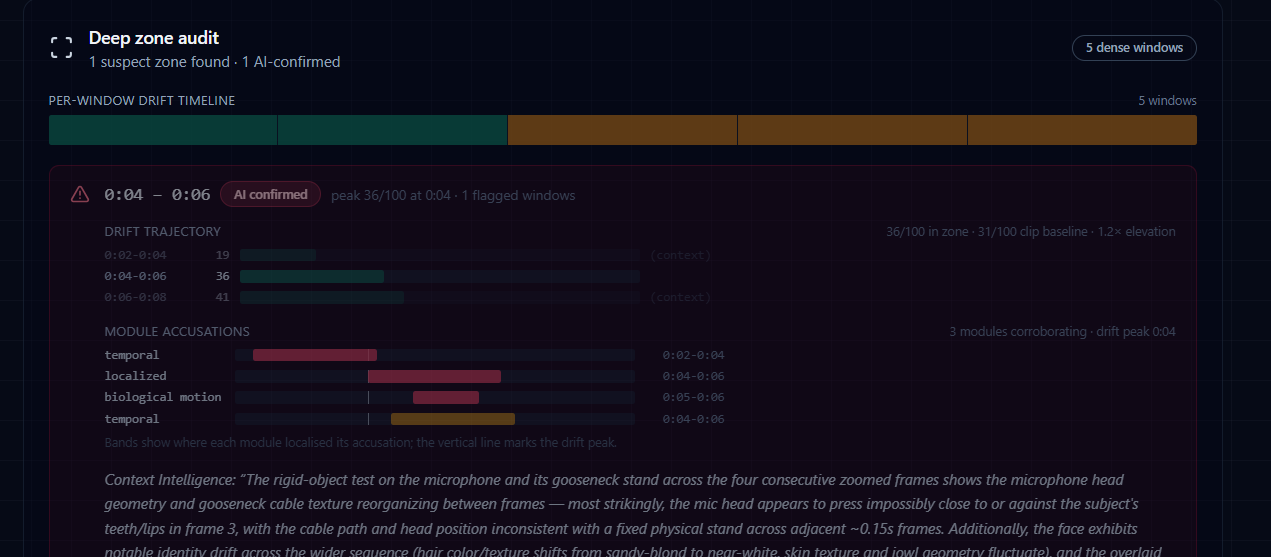
The deep-zone audit — one flagged window, AI-confirmed: the exact frames, the exact reasoning.
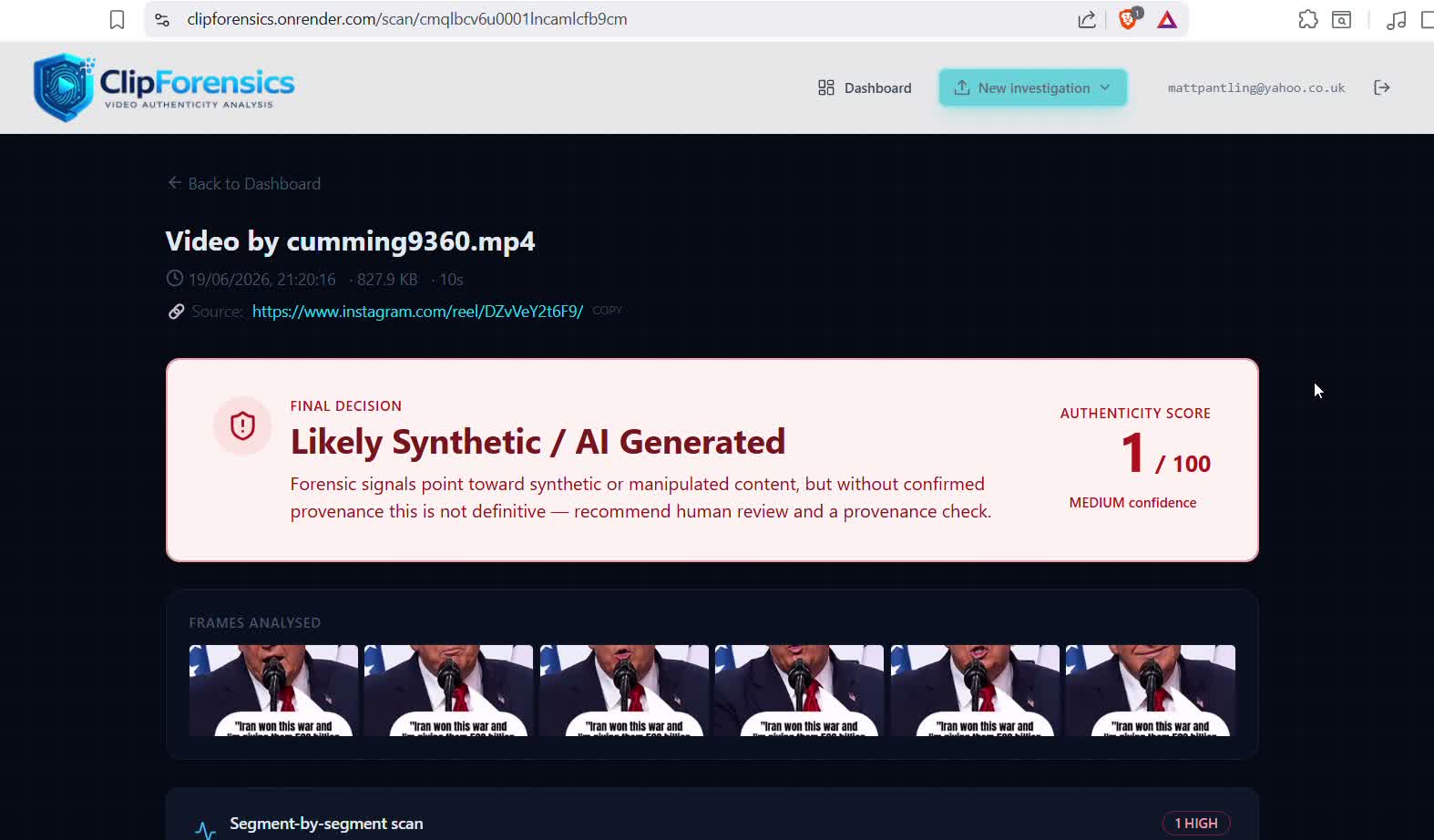
The verdict
AI-generated — scored 1/100, with the frames
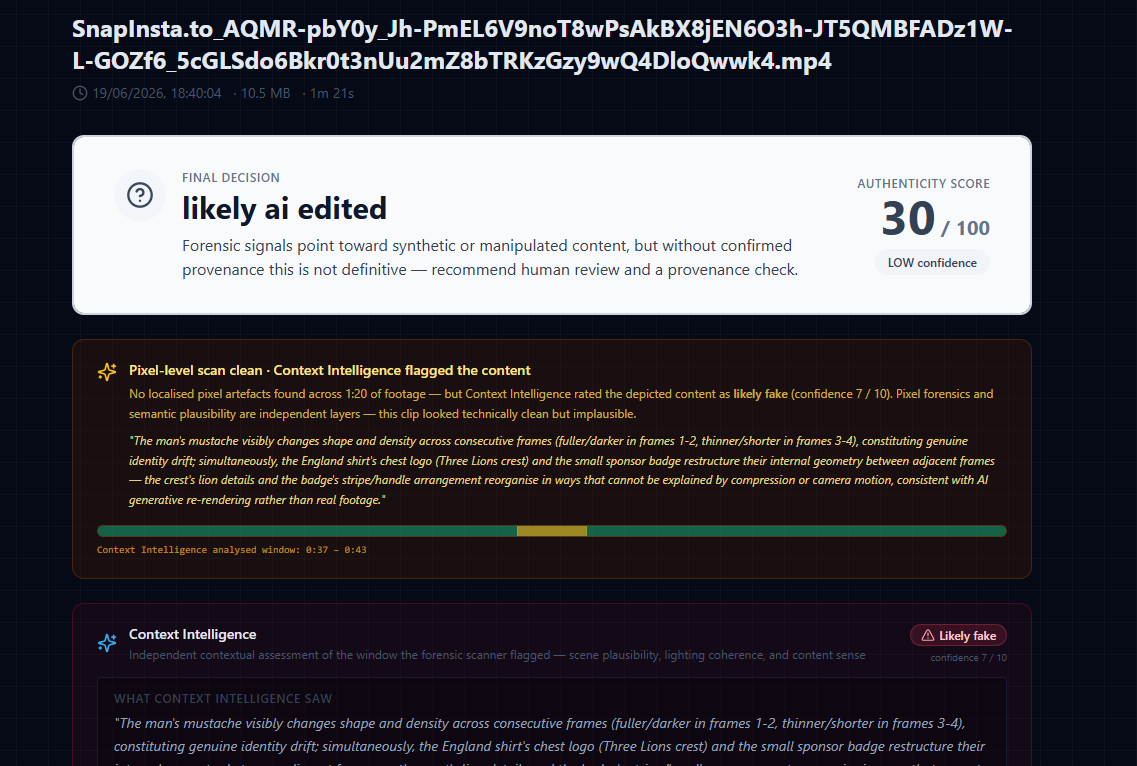
Context Intelligence
A reasoning layer cross-examines the pixels
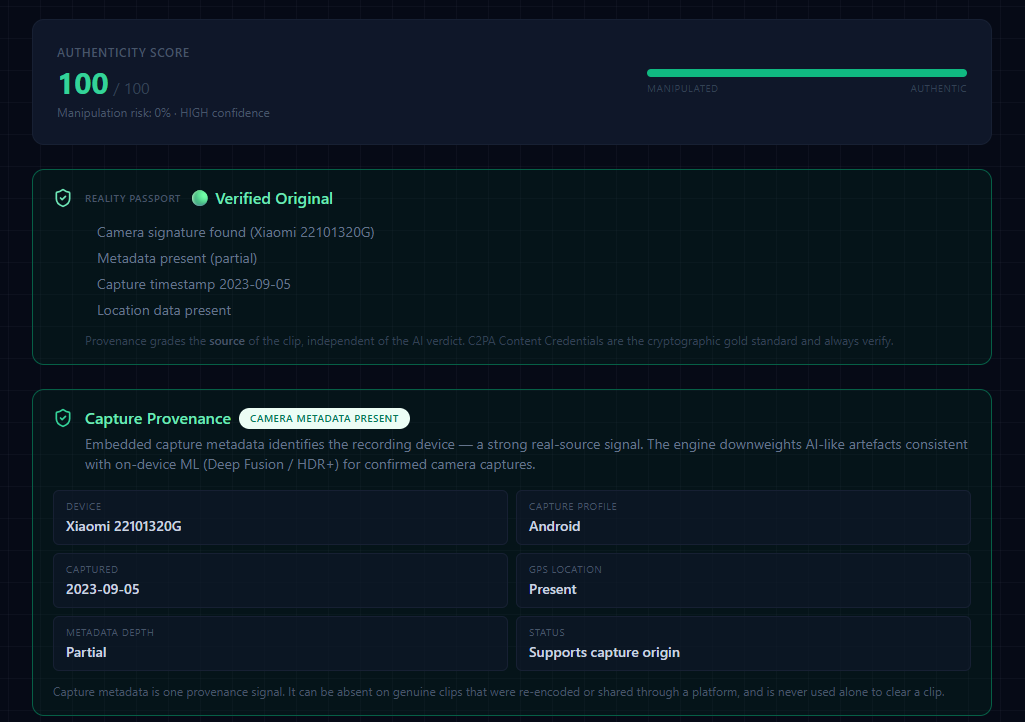
Cleared with confidence
Real footage, verified — no false alarms
How an investigation works
A code-based first pass. Then the confident call.
Every clip starts with a free, instant Detective scan. When it matters, escalate to the DCI Inspector for the reasoned, highest-confidence verdict.
Code-based first pass
Fast algorithmic forensics across every frame — a tripwire that flags what’s worth a closer look. It can be fooled both ways, so it never makes the confident call on its own.
- Instant · always free
- Flags the signal, not the verdict
The highest-confidence call
Deep-zone audits + Context Intelligence — frame-level reasoning over physics, motion and lighting, with named generator attribution. The verdict, the “why”, and who made it.
- Highest confidence + the reasoning
- Generator attribution + deep-zone timeline
We’re not big tech. The confident verdict runs real compute — our most powerful context-led intelligence, reasoning over every frame. That cost is what the DCI Inspector covers, and why it’s the paid layer.
The detective standard
We tell you when we don’t know.
Every other AI detector gives confident answers and is sometimes catastrophically wrong. We’re calibrated to say INCONCLUSIVE when the signal is genuinely mixed — because telling you “we’re not sure” is more useful than guessing.
Calibrated uncertainty
Six verdict bands, not two. Confidence levels published with every result.
Documented limits
We publish what we miss. The detection-limitations page is the first one we wrote.
Show your work
Per-module scores. Evidence timeline. Every verdict comes with the receipts.
15
Forensic Signals
6
Verdict Bands
< 60s
Avg Analysis Time
✓
Shareable Evidence Trail
What a verdict looks like
Receipts, not vibes
Every scan produces a detailed breakdown of forensic signals, an evidence timeline, and a clear verdict band.
Likely AI-Edited
Completed in 47 seconds
42/100
Trust Score
Signals Detected
Optical Flow Anomaly
28/100Unnatural motion patterns in frames 47-82
Lighting Inconsistency
45/100Shadow direction shifts between regions
Compression Mismatch
52/100JPEG quality differs across face region
Metadata Intact
85/100Container metadata consistent with stated source
Sample report. Real reports include all 15 modules plus C2PA provenance and a per-segment evidence timeline.
Try it freeThe Case Files
This week’s investigations
Real forensic case files on viral clips and the videos that broke the internet. Read like a detective, not like a press release.
How Investigators Analyse Suspicious Viral Videos
A comprehensive look at the forensic workflow used to investigate suspicious viral videos — from initial evidence collection to multi-signal analysis and final verdict.
May 25, 2026
The Deepfake Arms Race: Creators vs Detectors
An investigation into the ongoing battle between deepfake creators and forensic detectors — the techniques used on both sides and where the advantage currently lies.
May 21, 2026
Why Some Deepfake Videos Are Easier to Detect
Not all deepfakes are equally hard to detect. This investigation explains which factors make forensic analysis easier — and which make it nearly impossible.
May 17, 2026
Built for anyone who needs to know
Professionals who can’t publish a fake, and the curious who saw something that didn’t feel right.
How It Works
Six layers. One verdict.
Every clip goes through the full pipeline. No single check decides the verdict.
Cryptographic provenance
If the file carries C2PA content credentials from Sora, Veo, Adobe, Nikon, or Sony, we read the signature directly. Cryptographic proof, not statistics.
Upload or URL
Submit any video file or paste a YouTube, TikTok, X, Reddit, Instagram, or direct MP4 link.
Frame & audio extraction
FFmpeg extracts up to 20 representative frames plus the audio tracks.
15 forensic modules in parallel
Metadata, spectral, face, compression, optical flow, biological motion, lighting, audio synthesis, and more — each module runs independently.
Evidence fusion + sanity check
Weighted scoring with agreement bonuses and contradiction penalties. A multimodal LLM runs an independent sanity pass.
Verdict, score, evidence trail
Clear verdict band, calibrated confidence, per-segment evidence timeline, and a downloadable report.
Forensic Modules
15 independent analysis dimensions
Each module examines the clip from a different angle. Results are fused with weighted confidence scoring.
Provenance (C2PA)
Cryptographic content credentials from Sora, Veo, Adobe, Nikon, Sony
Metadata
Encoder tags, container, creation metadata
Compression
Codec signatures, bitrate patterns, GOP analysis
Compression History
Encoding chain reconstruction
Artifact Detection
GAN checkerboard, ELA, noise analysis
Temporal Consistency
Frame-to-frame coherence checks
Face Manipulation
Deepfake-specific facial anomalies
Lip Sync
Audio-visual synchronization analysis
Audio Synthesis
Voice cloning and TTS detection
Optical Flow
Motion physics plausibility
Spectral Analysis
Frequency domain anomaly detection
Biological Motion
Human movement naturalness
Lighting
Illumination consistency analysis
Localized
Region-specific manipulation mapping
Context Intelligence
Independent scene-plausibility & content reasoning
Clear verdict bands
Six categories. We never claim certainty — we present assessed risk, and we say inconclusive when the evidence is genuinely mixed.
Verified Origin
Cryptographic content credentials verify provenance.
Likely Authentic
No significant manipulation detected.
Likely AI-Edited
Indicators suggest AI modifications to real footage.
Likely AI-Generated
Multiple signals suggest synthetic origin.
High Manipulation Risk
Strong evidence of manipulation.
Inconclusive
The signal is genuinely mixed. We say so.
Start free. Escalate when it matters.
Free Detective scans, no card. Upgrade to the DCI Inspector for the reasoned, confident verdict.