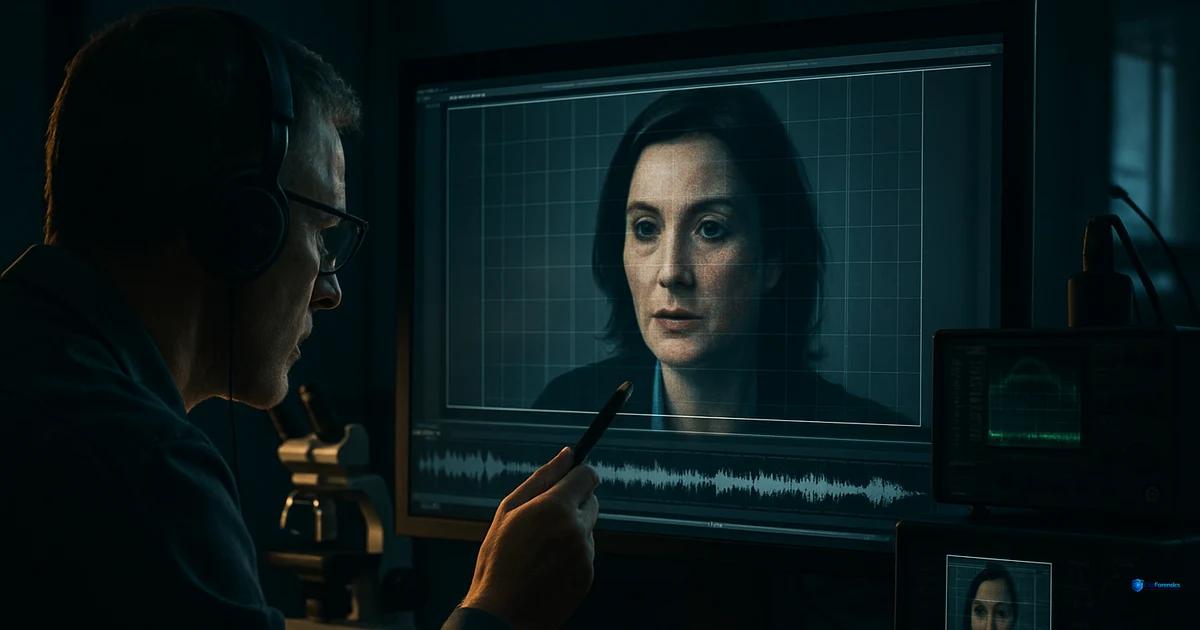
How to Detect a Deepfake Video in 2026
What actually works for detecting deepfake video right now — the quick checks, the investigative tools, and the forensic scoring methods that separate signal from noise.
Detecting a deepfake video in 2026 is harder than it was a year ago and easier than it will be next year. That is the nature of the arms race between generation and detection. But practical deepfake detection is not about magic — it is about systematic investigation using the right combination of quick checks, forensic tools, and informed judgment.
This guide gives you a working detection workflow — the same general approach used by journalists, fact-checkers, and forensic analysts — adapted for the current generation of AI video tools.
Step 1: Quick visual triage
Before running any tools, spend 30 seconds on a visual check. Play the video at full speed, then again at 0.25x. Look for:
- Hand anomalies (extra fingers, merging digits)
- Text or signage that shifts or garbles between frames
- Hair or clothing that phases through the body
- Background elements that morph or disappear
- Skin texture inconsistencies at face boundaries
- Eye reflections that differ between left and right
If you spot any of these, you have a strong preliminary indicator. But their absence does not mean the video is authentic — it means you need deeper analysis.
Step 2: Check the source
Before analyzing the video itself, investigate where it came from:
- Account age and history: New or anonymous accounts sharing sensational footage warrant extra scrutiny.
- First appearance: When did this video first surface online? Use reverse video search tools and social media timestamps.
- Context consistency: Does the video match the claimed event? Check weather, landmarks, language, and other contextual details.
- Multiple sources: Authentic events usually have multiple independent recordings. A single-source viral video is more suspect.
Step 3: Run multi-signal forensic analysis
Visual checks and source verification are necessary but insufficient. To detect deepfake video reliably, you need forensic analysis that examines signals invisible to human perception.
Upload the video to ClipForensics or a comparable multi-signal platform. A credible forensic analysis should include:
| Analysis Dimension | What It Checks | Why It Matters |
|---|---|---|
| Metadata | Encoder tags, timestamps, camera identifiers | Reveals processing history before pixel analysis |
| Compression | Re-encoding artifacts, quantization patterns | Detects editing even when visual content looks clean |
| Visual artifacts | ELA, noise patterns, spectral anomalies | Catches generator-specific forensic traces |
| Temporal consistency | Frame-to-frame coherence, resolution jumps | Exploits the difficulty of maintaining consistency over time |
| Face analysis | Boundary artifacts, skin texture, gaze | Specifically targets face-swap deepfakes |
| Audio | Voice synthesis, lip-sync, cross-modal timing | Catches audio manipulation even when video looks real |
Step 4: Interpret the results
A forensic report is evidence, not a verdict. Here is how to interpret it:
- Look at the confidence level. A verdict with high confidence across multiple modules is stronger than a single module raising a flag.
- Check the evidence timeline. Are manipulation indicators concentrated in a specific segment, or distributed throughout the video?
- Look for module agreement. When metadata, compression, and visual analysis all point to manipulation — that convergence is meaningful.
- Respect "Inconclusive." When evidence is insufficient or contradictory, an honest system says so. Do not force a verdict.
What makes 2026 different
The deepfake landscape has shifted in several important ways:
- Text-to-video generators can now produce minutes of coherent video, not just seconds. This means fully generated misinformation content is now practical.
- Real-time face-swap tools enable live deepfaking in video calls, creating new fraud vectors beyond pre-recorded content.
- C2PA content credentials are appearing in production devices, giving provenance verification a practical foundation for the first time.
- Multi-signal detection has matured. Single-classifier approaches are increasingly recognized as inadequate for real-world use.
Common mistakes to avoid
- Relying on one tool. No single detector catches everything. Cross-reference results from multiple analysis methods.
- Trusting a percentage without evidence. A tool that says "92% fake" without explaining why is not providing forensic evidence — it is providing a guess.
- Ignoring compression context. A video that has been downloaded, re-uploaded, screen-recorded, and re-uploaded again will have degraded forensic signals regardless of its authenticity.
- Confusing technical with contextual manipulation. Forensic tools detect technical manipulation (splicing, generation, face swaps). They do not detect misleading framing, selective editing, or out-of-context sharing.
Frequently asked questions
What is the fastest way to check if a video is a deepfake?
Quick visual triage (hands, text, physics) takes 30 seconds. For forensic confirmation, upload to a multi-signal platform like ClipForensics — automated analysis completes in under 60 seconds. Combine both for the fastest reliable assessment.
Are free deepfake detection tools reliable?
Free tools vary widely. Single-classifier web tools often have high false positive rates and limited generalization. Look for tools that explain their reasoning, report confidence levels, and analyze multiple signal types rather than just running a single model.
Can I detect deepfakes on my phone?
Basic visual checks can be done on any device. Forensic analysis requires computational resources that mobile devices cannot provide efficiently. The most practical approach is to upload suspect video to a cloud-based analysis platform and review the results on your phone.
How accurate is deepfake detection in 2026?
Accuracy depends on the video quality, the generation method, and the detection system. No tool achieves 100% accuracy. Multi-signal systems with 10+ forensic modules consistently outperform single-classifier approaches. The honest answer is that detection is probabilistic, and credible tools report confidence intervals rather than claiming certainty.
What should I do if I find a deepfake?
Preserve the original file and source URL. Run forensic analysis and save the report. If the video is spreading misinformation, report it to the platform. If it involves a crime (fraud, non-consensual imagery), contact law enforcement with your evidence documentation.