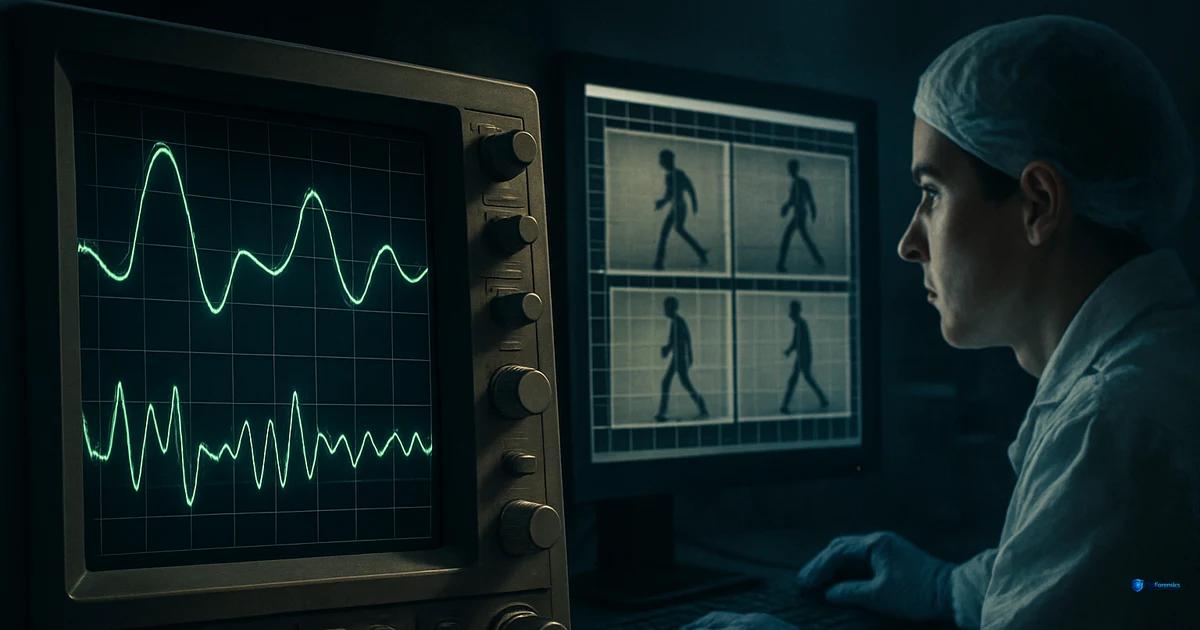
Biological Motion and AI Video Detection
Decades of biological motion research reveal that human movement follows patterns AI generators struggle to replicate. These patterns become forensic signals.
Biological Motion and AI Video Detection
Human observers are remarkably sensitive to biological motion — the characteristic movement patterns produced by living organisms. This perceptual ability, studied for decades in vision science, is now informing a new class of forensic signals for detecting AI-generated video. Because current generative models approximate movement statistically rather than simulating it physically, subtle biomechanical implausibilities can serve as indicators of synthetic content.
What Is Biological Motion Perception?
The study of biological motion perception traces back to Gunnar Johansson's pioneering point-light walker experiments in the 1970s. Johansson attached small lights to the major joints of human actors and filmed them moving in darkness. Despite seeing only a sparse set of moving dots, observers could immediately recognize that they were watching a person walking, running, or dancing. They could even infer the walker's gender, emotional state, and identity from these minimal cues.
This research demonstrated that the human visual system is finely tuned to the dynamics of biological movement — not just static form. The temporal relationships between joint positions, the subtle accelerations and decelerations of limbs, and the coordination between body parts all carry information that our perceptual systems extract effortlessly.
Natural Motion Signatures
Real human movement is governed by physics, anatomy, and neuromuscular control. Several characteristics distinguish authentic biological motion from statistical approximations:
- Anticipatory postural adjustments (APAs): Before initiating a voluntary movement — reaching for an object, stepping forward, lifting a weight — the human body makes preparatory adjustments to maintain balance. These adjustments typically begin 50–200 milliseconds before the primary movement and involve subtle shifts in the center of mass, trunk stabilization, and compensatory muscle activations. AI-generated figures may initiate movements without these preparatory phases.
- Coupled limb movements: When a person walks, the arms swing in counter-phase with the legs — not because arm-swinging is the "goal," but because it emerges naturally from angular momentum conservation. Similarly, head movements are coupled to gait, and trunk rotation is linked to stride. These couplings follow predictable phase relationships that can be measured and compared against biomechanical norms.
- Center-of-mass dynamics: A walking person's center of mass follows a sinusoidal trajectory — rising during single-leg support and falling during double support. The amplitude and frequency of this oscillation are constrained by leg length, walking speed, and gravity. Generated videos may produce movement where the apparent center of mass does not follow physically plausible trajectories.
- Micro-movements and postural sway: Even when standing "still," a living person exhibits continuous small oscillations — postural sway — driven by the feedback loops of the balance control system. The frequency and amplitude of this sway fall within characteristic ranges. A synthetically generated person who is perfectly still (or whose micro-movements have incorrect statistical properties) may be distinguishable on this basis.
Why AI Fails at Biological Motion
Current video generation models — whether based on diffusion, autoregression, or hybrid architectures — learn to produce motion from statistical patterns in training data. They do not have access to an internal physics engine, a biomechanical model, or an understanding of gravity, inertia, or muscle physiology. As a result:
- Movements may appear superficially correct but lack the underlying physical constraints that govern real motion. Limbs may move smoothly but with incorrect acceleration profiles.
- Inter-limb coordination may break down, especially for complex movements like climbing, dancing, or interacting with objects. The phase relationships between arms and legs may be inconsistent or absent.
- Weight and inertia may not be convincingly conveyed — a generated person lifting a heavy object may not exhibit the postural adjustments, muscle tension, or deceleration patterns that a real person would.
- Transitions between movement types (walking to running, standing to sitting) can be particularly revealing, as these transitions involve complex biomechanical reorganization that statistical models may approximate poorly.
To understand how ClipForensics incorporates motion analysis alongside other forensic signals, see how our detection pipeline works.
Breathing and Micro-Movements as Forensic Signals
One of the subtler categories of biological motion is respiratory movement. When a real person speaks, sits, or stands, their torso exhibits rhythmic expansion and contraction at a rate typically between 12 and 20 breaths per minute. This breathing motion is coupled to speech (we exhale while speaking), to physical exertion, and to emotional state.
AI-generated video may omit breathing motion entirely, produce it with incorrect timing, or fail to synchronize it with speech and activity. Similarly, the small fidgeting movements, weight shifts, and eye saccades that characterize a living person at rest may be absent or statistically irregular in synthetic content. These micro-movement patterns can be extracted through motion magnification techniques and analyzed for consistency with biological norms.
Point-Light Analysis of AI-Generated vs. Real Humans
Inspired by Johansson's original experiments, some forensic approaches reduce video of human figures to point-light representations — tracking joint positions over time and discarding appearance information entirely. By analyzing the trajectories, velocities, and inter-joint correlations of these points, it becomes possible to assess whether the movement is biomechanically plausible without being influenced by the visual realism of the rendering.
Early research suggests that point-light representations of AI-generated humans can exhibit detectable anomalies: irregular velocity profiles, implausible joint angles, and broken coordination patterns. However, this area of forensic analysis is still developing, and its reliability varies significantly depending on the generator model, the type of movement depicted, and the video resolution.
Biological Motion Signals and Forensic Reliability
| Motion Signal | What It Measures | Forensic Reliability | Key Limitation | Best Use Case |
|---|---|---|---|---|
| Anticipatory Postural Adjustments | Pre-movement weight shifts and stabilization | Moderate | Requires high frame rate; subtle signal | Full-body movement initiation |
| Arm-Leg Phase Coupling | Counter-phase coordination during gait | Moderate–High | Only applicable to walking/running | Gait analysis in surveillance-style video |
| Center-of-Mass Trajectory | Vertical oscillation during locomotion | Moderate | Requires visible full body; resolution-dependent | Walking and standing sequences |
| Respiratory Motion | Chest/torso expansion at 12–20 BPM | Low–Moderate | Easily obscured by clothing or low resolution | Close-up or interview-style video |
| Postural Sway | Micro-oscillations during quiet standing | Low | Very small amplitude; needs high-res video | Static scenes with standing figures |
| Joint Velocity Profiles | Acceleration/deceleration patterns of limbs | Moderate | Varies by movement type and generator model | Complex movements (reaching, gesturing) |
Frequently Asked Questions
Can biological motion analysis detect all AI-generated videos?
No. Biological motion analysis is most useful when the video depicts human figures performing recognizable physical actions. It may be less informative for close-up face-only shots, static scenes, or content that has been heavily compressed or downsampled. It is one signal among many in a comprehensive forensic analysis pipeline.
How accurate is point-light analysis for deepfake detection?
Research in this area is still emerging. Point-light analysis can reveal biomechanical implausibilities in some AI-generated videos, but its accuracy depends heavily on video quality, the type of movement depicted, and the sophistication of the generator model. It should be treated as a supplementary forensic signal rather than a standalone detection method.
Will future AI models fix their biological motion problems?
It is likely that generative models will improve at producing biomechanically plausible motion over time, particularly as physics-informed training techniques and motion-capture datasets become more widely used. However, replicating the full complexity of human neuromuscular control remains a significant challenge. Forensic methods will need to evolve in parallel. For more on this topic, see our page on detection limitations.
Can I upload a video to check for biological motion anomalies?
Yes. You can upload a video through ClipForensics for analysis. Biological motion consistency may be assessed as part of the overall forensic evaluation. Results are expressed as probabilistic assessments — the system does not guarantee a definitive verdict on any single signal.
Does clothing or camera angle affect biological motion analysis?
Yes, significantly. Loose clothing can obscure joint positions and respiratory motion, making pose estimation less reliable. Extreme camera angles, heavy motion blur, and low frame rates can all degrade the quality of motion trajectory extraction. The analysis tends to be most informative when the subject is fully visible, the camera is relatively stable, and the video resolution and frame rate are adequate for reliable pose tracking.